© Export Finance Australia
The views expressed in World Risk Developments represent those of Export Finance Australia at the time of publication and are subject to change. They do not represent the views of the Australian Government. The information in this report is published for general information only and does not comprise advice or a recommendation of any kind. While Export Finance Australia endeavours to ensure this information is accurate and current at the time of publication, Export Finance Australia makes no representation or warranty as to its reliability, accuracy or completeness. To the maximum extent permitted by law, Export Finance Australia will not be liable to you or any other person for any loss or damage suffered or incurred by any person arising from any act, or failure to act, on the basis of any information or opinions contained in this report.
Australia—AUD rally erodes international competitiveness
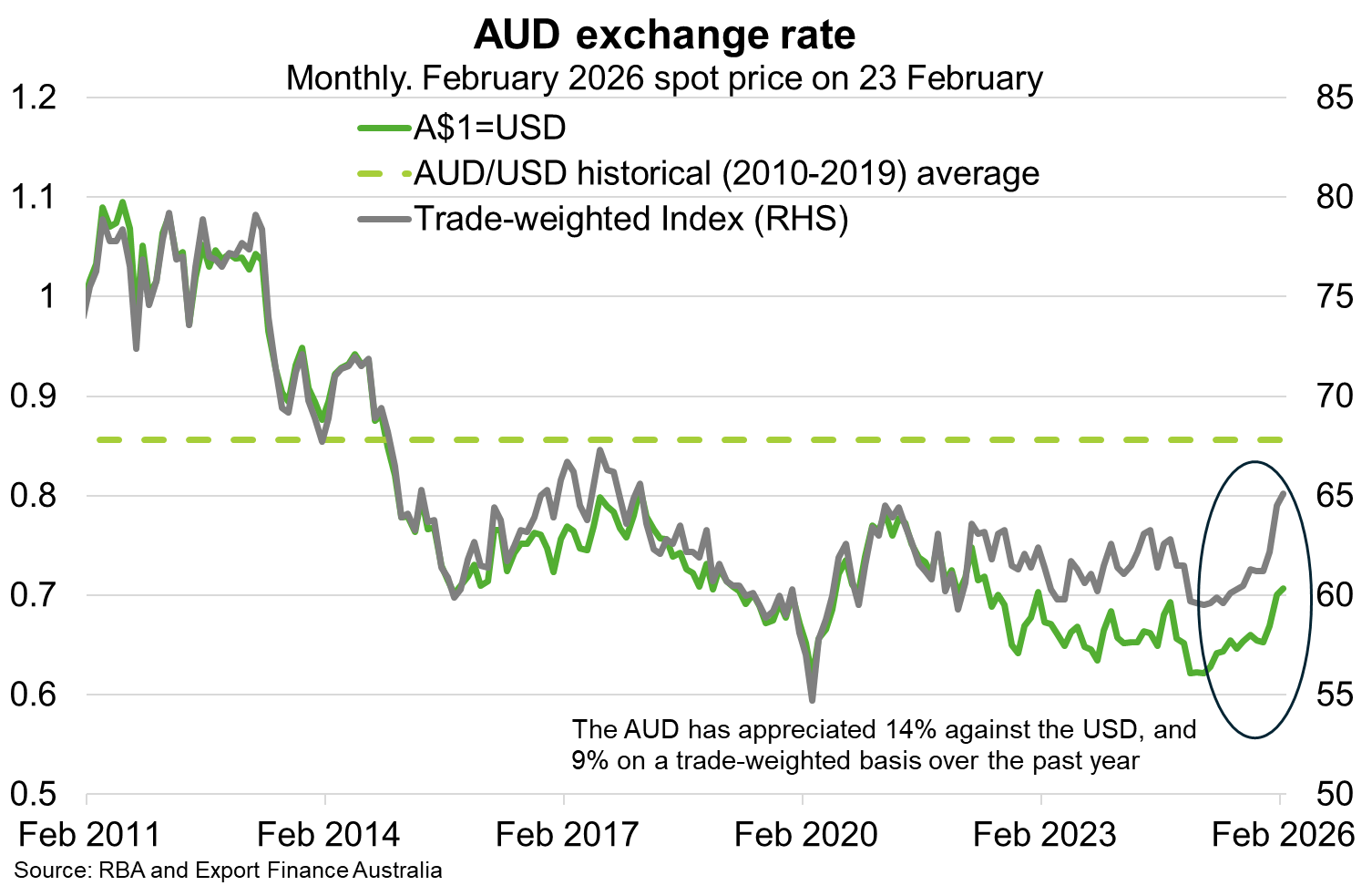
The Australian dollar (AUD) appreciated 14% against the US dollar (USD) over the past year with much of the growth in the last two months (Chart). At just over USD 0.70, the increased value of the AUD makes Australian exports less competitive when priced in international currencies, however, the AUD remains below the long term pre-pandemic average of USD 0.86.
Much of the AUD’s movement has been driven by USD depreciation. Indeed, the AUD appreciated only 9% against the RBA’s trade weighted index over the past year, which values the AUD against a basket of currencies weighted by share of total trade. Meanwhile, the USD has lost almost a tenth of its value against a basket of global currencies over the last year. USD depreciation is driven by expectations of lower interest rates in the US as inflationary pressures ease. Interest rates and currencies tend to move in the same direction; given higher interest rates attract foreign capital seeking better returns, increasing demand for the currency. Other factors driving the USD’s depreciation from its record high at the start of 2025 include investor uncertainty about US fiscal sustainability and institutional stability. In addition to USD depreciation, the AUD rally has been driven by a) expected monetary tightening by the Reserve Bank of Australia, which increases the interest rate differential between Australia and other advanced economies where central banks are expected to lower rates or hold steady, and b) generally strong commodity prices that support demand for the Australian currency and our growth-sensitive exports.
Should the AUD appreciation continue, as is expected by some forecasters, Australian exports would become less competitive globally. While the overall effect on Australian exports is likely to be negative, the silver lining is lower input costs as imports become less expensive in AUD terms.