© Export Finance Australia
The views expressed in World Risk Developments represent those of Export Finance Australia at the time of publication and are subject to change. They do not represent the views of the Australian Government. The information in this report is published for general information only and does not comprise advice or a recommendation of any kind. While Export Finance Australia endeavours to ensure this information is accurate and current at the time of publication, Export Finance Australia makes no representation or warranty as to its reliability, accuracy or completeness. To the maximum extent permitted by law, Export Finance Australia will not be liable to you or any other person for any loss or damage suffered or incurred by any person arising from any act, or failure to act, on the basis of any information or opinions contained in this report.
Thailand—Political certainty may improve economic performance
Thailand’s ruling conservative Bhumjaithai Party (BJT) won an unexpected decisive victory in general elections held on 8 February, securing approximately 193 out of 500 contested seats in the lower house of parliament. The opposition pro-reform People’s Party saw its seat count decline substantially to 118, despite the party coming second place. Absent a majority, the BJT will still need to secure a coalition government, led by Prime Minister Anutin Charnvirakul.
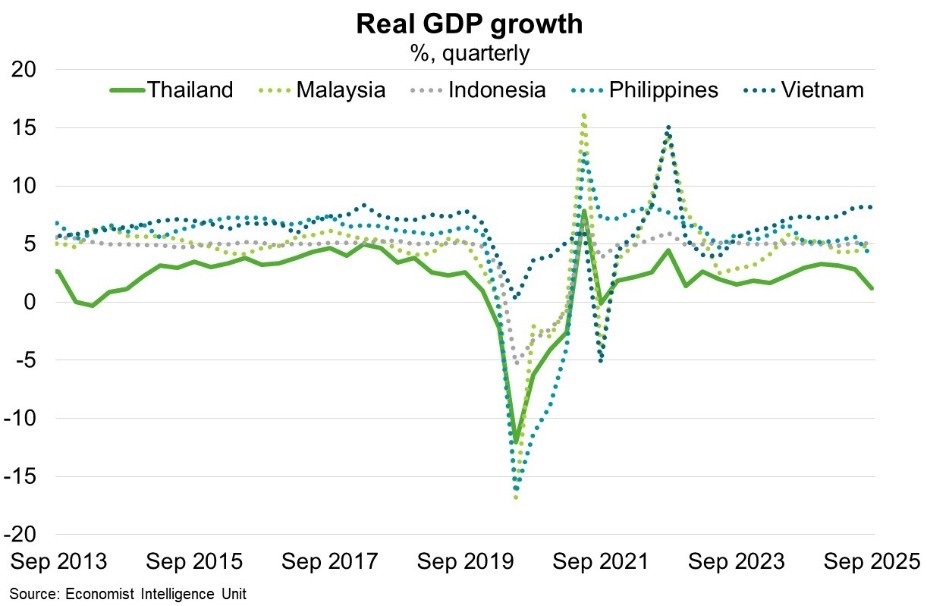
Despite Thailand’s large economic size, proximity to fast-growing Asian markets and favourable business environment, the country has long underperformed ASEAN peers (Chart). This reflects structural weaknesses, including low investment, sluggish productivity growth, demographic aging, barriers to competition and political instability. However, a stable BJT-led government with a strong mandate and pro-business agenda could improve policy predictability and delivery, boost economic growth and attract more foreign direct investment that is critical to Thailand’s manufacturing export industry. Prime Minister Anutin’s prioritisation of Thailand’s OECD accession bid also gives optimism that Thailand may undertake the important economic and social reforms required to lift growth. Indeed, Thailand’s stocks and currency rose following the election result, suggesting political stability prospects and the continuation of business-friendly policies has bolstered investor confidence. A longer-tenured government could also shift emphasis from short term fiscal stimulus measures to a consistent fiscal policy framework that steadies the government's balance sheet within the government’s public debt limit, currently 70% of GDP. Public debt reached 65% of GDP by end-FY2025, up from 41% in 2019, leaving limited space to respond to adverse shocks.
Australia’s exports to Thailand have grown by an annual average 12% over the five years to FY2025, to $8.6 billion. Export opportunities may increase to the extent that improved political stability strengthens the economic outlook.