© Export Finance Australia
The views expressed in World Risk Developments represent those of Export Finance Australia at the time of publication and are subject to change. They do not represent the views of the Australian Government. The information in this report is published for general information only and does not comprise advice or a recommendation of any kind. While Export Finance Australia endeavours to ensure this information is accurate and current at the time of publication, Export Finance Australia makes no representation or warranty as to its reliability, accuracy or completeness. To the maximum extent permitted by law, Export Finance Australia will not be liable to you or any other person for any loss or damage suffered or incurred by any person arising from any act, or failure to act, on the basis of any information or opinions contained in this report.
Australia—Manufacturing reverses decades long trend, headwinds remain
Australian manufacturing outperformed broader industry growth in both 2024 and 2025, interrupting a decades-long period of below-average expansion. The share of manufacturing in the economy rose to 7.34% in 2025 from a multi-decade low of 7.19% in 2023. Momentum has continued into 2026, with sector output increasing 3.2% y/y in Q1 2026, compared with national GDP growth of 2.5%, contributing 0.1 percentage points to overall economic growth.
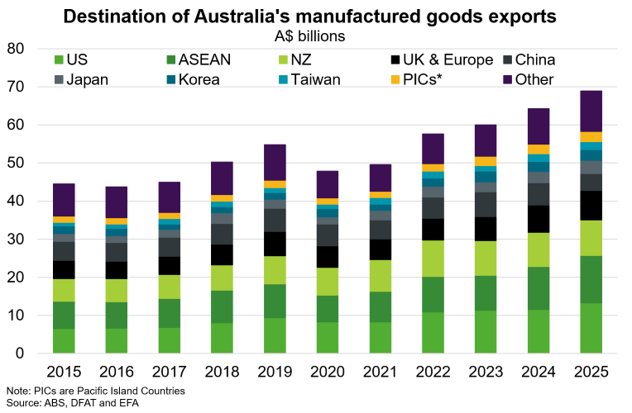
Food products manufacturing, which represents 22% of the sector, was the largest contributor to recent gains, expanding by 8% y/y in 2025. Other strong performers included fabricated metals (11% of the sector, up 7%), chemicals (8%, up 11%), transport equipment (10%, up 7%) and machinery and equipment (14%, up 4%). Food manufacturing has been a persistent bright spot, averaging 7% annual growth over the past five years. As Australian manufacturers satisfy domestic demand, manufacturers are increasingly looking to overseas markets for further growth. Indeed, Australia’s manufactured goods exports have risen steadily in recent years (Chart). While the US remains our largest export destination for manufactured goods, export growth over the past five years has been strongest in India, Taiwan, Japan and ASEAN markets.
In July, the US imposed section 301 forced labour tariffs of 12.5% on Australia, and between 10 to 12.5% on 59 other economies. These replaced the earlier 10% section 122 ‘Temporary Import Surcharge’ imposed in February, when the US Supreme Court ruled against the earlier ‘Liberation Day’ tariffs imposed in April 2025. However, several other economies are facing tariffs in addition to the section 301 forced labour tariffs, and 70% of our exports to the US still enter duty-free.