© Export Finance Australia
The views expressed in World Risk Developments represent those of Export Finance Australia at the time of publication and are subject to change. They do not represent the views of the Australian Government. The information in this report is published for general information only and does not comprise advice or a recommendation of any kind. While Export Finance Australia endeavours to ensure this information is accurate and current at the time of publication, Export Finance Australia makes no representation or warranty as to its reliability, accuracy or completeness. To the maximum extent permitted by law, Export Finance Australia will not be liable to you or any other person for any loss or damage suffered or incurred by any person arising from any act, or failure to act, on the basis of any information or opinions contained in this report.
Southeast Asia—Macroeconomic risks diverge across the region
Southeast Asia’s continued strong economic performance reflects rising participation in global technology value chains. However, uncertainty remains elevated with risks stemming from the ongoing Middle East conflict, the scale and durability of the AI investment cycle, financial market volatility, further tariff measures targeting the region, and weaker growth in China. Countries with persistent large twin fiscal and current account deficits (the trade balance forms a component of the latter) have increased exposure to shifts in investor sentiment. Impacts could be felt through capital outflows, higher refinancing costs, exchange rate depreciation, or pressure on foreign exchange reserves in economies with managed currencies. Vulnerabilities are greater where external debt is short term, economic buffers are limited, and foreign investors hold a large share of government debt.
Recent shocks, including elevated energy prices, rising trade protectionism and the AI-driven investment boom, have layered impacts on ASEAN economies. While Singapore remains the exception, most ASEAN countries run fiscal deficits and several expanded energy subsidies to shield households and businesses from higher costs. This has increased fiscal pressures in Indonesia, Malaysia, Vietnam, Thailand and the Philippines. Current account dynamics have been more varied. Vietnam, Singapore and Malaysia benefit from strong semiconductor and electronics exports, offsetting higher energy and manufacturing input costs. However, higher energy and industrial imports in Thailand and the Philippines alongside weaker tourism (Thailand) and Gulf remittances (Philippines) are worsening current account balances. Indonesia also sees wider current account deficits as import demand outpaces gains from higher commodity exports.
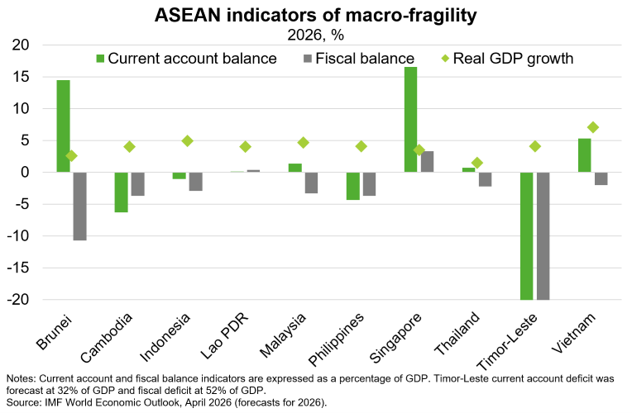
Overall, “twin deficits”—expected in Indonesia, Philippines, Cambodia and Timor-Leste (Chart)—signal increased susceptibility to shocks rather than an imminent crisis. Robust growth helps offset vulnerabilities, with recent ADB forecasts suggesting strong growth for Vietnam (7.2%), Indonesia (5.2%), Malaysia (4.6%), Cambodia (4.1%), Timor-Leste (3.8%), Philippines (3.8%) and Singapore (3.2%).